

Designers trade fashion’s usual murmur for something more declarative
Words by Kyle rice
Fashion has always been political. Perhaps more famously, military dress—its textiles and coded silhouettes—has long signaled allegiance: which side you chose, or were conscripted into. The insurgents, in turn, reworked those same uniforms into something defiant. Think of 1970s punks, who took the language of authority and tore it apart.
And yet fashion, as an industry, rarely plants a flag outright. It prefers implication, letting the clothes speak. That’s what made New York Fashion Week this season feel different—less coded, more declarative.
To the surprise of many, several designers made their position quite clear, opposing U.S. Immigration and Customs Enforcement (ICE). Rachel Scott of Diotima, Hillary Taymour of Collina Strada, and Henry Zankov of his namesake label were decorated in prominent “ICE OUT” pins—a visible rebuke of masked enforcement tactics and deportation raids in American cities.
Immigrants are not peripheral to fashion. They are its infrastructure. They cut the patterns, run the sewing floors, ship the garments, style the shows. They are also, undeniably, its point of view. Without immigrant labor and influence, New York fashion does not function.
So instead of the usual murmur that defines this industry’s politics, there was something closer to a collective roar—still often embedded in the work itself, but also sometimes quite literal.
That undercurrent feels especially present in the work of Patricio Campillo, whose FW26 collection insists you confront his Mexican heritage head-on. He doesn’t offer it up as reference; he asks you to stand inside it, to walk in the same shoes as the models he sends down the runway.
IN MANHATTAN’S FAR WEST EDGE, high above the Hudson at The Standard, High Line, his team moves briskly backstage. Last season, the show unfolded on a vast concrete floor wrapped in glass, the East River stretching out in the distance. What struck me back then was the calm. Assistants darted from fitting to tailoring and back again without panic. Everything felt methodical. Considered.
Today, the quarters are tighter, the ceilings lower, but the feeling of the room remains the same. Focused. Eased. Intentional.
Between the shuffle of workers, I catch glimpses of the shoes, a collaboration with the Portuguese label Mariano: Chelsea-style boots in sober neutrals and saturated jewel tones; loafers wrapped in horsehair with artisanal leather soles. One pair—a deep burgundy boot, sliced with a diagonal seam—catches my eye. A model spots me angling for a photo and, amused, extends their foot obligingly, offering heel and profile before we share a laugh. Then they’re called for the first walk-through.
As the rest of the models are whisked away, a collective exhale settles over the room.
I slip toward Patricio just before the room picks up again. He greets me with a warm, steady smile and a “Nice to see you again,” before noticing my eyes land on the same “ICE OUT” pin fastened to his jacket.
“It’s important to speak up for everyone who’s being affected by ICE,” he says without hesitation.
How refreshing. In years past, an invitation to talk politics might prompt a retreat. Designers would stiffen or avoid eye contact—too risky, too easily misread. With Patricio, it feels fluid. He doesn’t wince. Maybe that’s why his shows run with such composure. A team reflects its leader, and with Patricio, that conviction reads clearly.
As I press him about the collection, a “dialogue between possibility and restraint,” as he frames it, I find myself momentarily mesmerized by the discipline of it all. The horsehair first seen on the loafers reappears sparingly on trenches and blazers. The diagonal seam slicing through those leather boots mirrors a detail on supple leather duffles, developed with another Portuguese label, Belcinto. Nothing feels decorative. Everything answers to something else. Patricio has always been a storyteller; this season, the narrative feels especially tender.
“It’s only human to think of love as a language rather than hate,” he adds, plainspoken. That kind of clarity lingers. And it reframes the politics here as necessity rather than performance.
AT KALLMEYER, positioned just east in Manhattan’s financial district, that same current of conviction runs just as steady. There are real embraces here amongst the crowd. For founder Daniella Kallmeyer and her team, fashion week doubles as a reunion—a rare moment when the orbiting bodies of this industry collide again.
But as much as this moment calls for celebration, it wouldn’t be a reunion without a bit of drama. Especially when prominent American critic Rachel Tashjian—who dismissed the brand as “boring” last season, pointedly asking, “If this woman is so discerning, is she really going to buy all these clothes?”—sits front row at the show.
This isn’t politics in the traditional fashion. Rather, the politics of navigating the age long dual of designer versus critic.
Admittedly, I too was initially puzzled by Daniella’s restraint back in September. While many brands looked to produce more product, she insisted on showcasing a limited number of looks and shoe styles. A focus on minimalism and practicality. “We all have hundreds of shoes,” she said to me then, “but don’t we really just wear the same four?”
Today, the edit tightens even further. One silhouette of shoe. That’s it. Rendered in different fabrics, yes—but fundamentally one idea: a kitten heel with an elongated toe, chopped blunt at the end. It appears as boots, slingbacks (and perhaps a mule, if I wasn’t mistaken). How bold to propose a single shape and stand by it. In this context, Daniella’s insistence on staying precisely in the lane she’s paved feels less defensive and more resolute. The refusal to zig when prodded to zag is its own kind of protest.
“The heel is just high enough, the toe just pointed enough. It’s meant to work in every wardrobe, in every scenario,” she notes of her collaboration with footwear brand JJ Heitor.
Kallmeyer designs the way some of us shop: carefully and with intent. In that sense, she truly puts herself in the buyer’s shoes, anticipating need and desire. “They’re a little cheeky and a little lady,” she adds. “Softer. More glove-like. Easy to throw around. You don’t have to take them so seriously.”
To Daniella’s credit, she knows exactly who she’s designing for. Veering off course would feel counterintuitive to the business she’s methodically built and sustained. One shoe silhouette, rigorously explored, aligns with that logic. It sharpens the message. And I suspect her customer (yes, discerning) will lean in rather than look away.
Tashjian might have won the initial battle, but Daniella is playing a longer game.
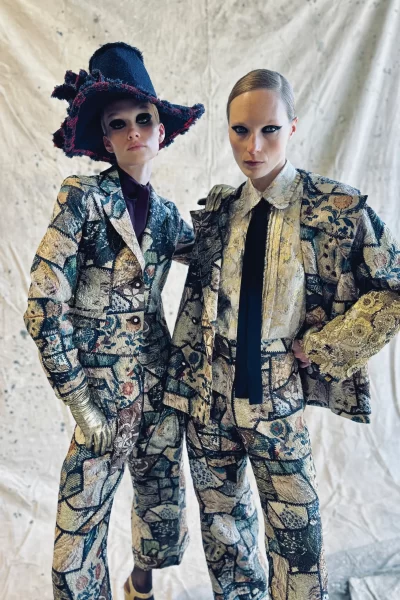
IN SHARP CONTRAST, Johnson Hartig, founder of Libertine, operates in a different lane—one closer to confection. His clothes are not for every woman, but for the woman: bold and unrestrained. He tells me this season is “much more muted.” Perhaps by Libertine standards, where exuberance is baseline. But to many, the work reads as exuberant all the same.
Consider a geometric suede patchwork knee-high boot, created in collaboration with Helena Mar. In a moment when so many feet are clad in understatement, Hartig offers you something declarative.
Bravado like this feels increasingly rare. We live in a culture seduced by minimalism, where Carolyn Bessette-Kennedy remains the image for immaculate restraint. Clean lines. Neutral palettes. But there is still a case to be made for the ornamental. That’s where Libertine thrives, and where its politics quietly sit.
Looking at the collection, I try to follow where it leads. Maybe to a riverside café, dressed in a muted tweed jacket, worn-in denim, and a flash of pink kissing the tips of the mary-janes he debuts this season. Or to a cocktail evening, where I don a slouchy black tuxedo with a glint of gold at the toe—just enough to catch the light. Though conceived for the daring woman, I can just as easily see these pieces slipping into the wardrobe of the brash man.
And this is where his politics unknowingly lie—in the codes of menswear. For decades, the boundaries of gendered dress stood firm in their respective corners. But the edges have softened. I think of Harry Styles in this context: an artist who treats traditional norms as suggestions rather than statutes. He’s worn mary-janes and ballet flats across red carpets and album covers, normalizing what once felt theatrical. At the end of the day, it’s just clothes.
Libertine doesn’t issue this idea as a manifesto. Hartig isn’t pounding a podium. But he does create moments that suggest redefining the rules. Young men wrapped in frilled embroidered jackets and unapologetic patterns. Tweeds once reserved for the Upper East Side matriarch now shape men’s suiting.
When I float the idea of the mary-jane-wearing man back to him, he laughs—delighted, not defensive. “Well, that taupey color with the pink is particularly kind of chic and younger,” he says. It’s an answer that’s more suggestive than strident, style remaining an invitation for the wearer.
Some designers display the pin. Others reshape a silhouette. Some tighten to a single shoe; others slice suede into geometry. Some speak plainly; others let the work carry the weight. None of it exists in a vacuum.
Fashion may resist planting flags. But whether whispered through restraint or shouted, it is always staking ground.